Before Washington ramps up yet another losing war on drugs, it should take a clear-eyed look at how its current strategies are affecting the supply and demand of drugs. Congressman Eliot Engel (D) of New York has introduced a bill to do just that.
Washington would be wise to back Congressman Engel's initiative because there has not been a thorough, frank evaluation of the fight against drugs in decades. The drug czar office's annual report is not enough. Recommendations by an independent commission, however, could generate the consensus and strategy we sorely need.
The cornerstone of US drug policy at home and abroad is to reduce the drug supply (from crop eradication to border seizures) in order to increase the domestic price of drugs. The idea is to deter both potential consumers and producers from entering the drug market.
It hasn't.
Since May 1971, when President Richard Nixon proclaimed a "war on drugs," Washington and the Western Hemisphere have been unable to win it. Every claimed victory has turned out to be, in the end, a fiasco.
This article is like a lot of the really well written articles promoting various measures to rethink the drug war. The significance here is that during the spate of magazines encouraging marijuana's legalization in the spring, the Christian Science Monitor's editorial board wrote a lengthy article opposing legalization, becoming one of the rare legitimate news sources to come out and oppose the rethinking of our drug laws.
Charles Bowden has done a lot of reporting on how the drug war has been affecting Mexico and he has some real interesting things to say on the issue. What drew me most from this interview was:
What people have to understand is Mexico would collapse without drug money. Our agencies estimate Mexico earns $30 billion to $50 billion a year in foreign currency from selling drugs. Remittances from Mexican workers here is their number two official source of currency, and that’s about $20-$25 billion. But the drug industry is essential. It’s penetrated the whole culture, and it isn’t going away. And nobody is going to destroy it.
I’ll give you another statistic. The consumption of drugs in Mexico has exploded. Last week, a public health official in Juarez, a city of a million and a half, said there’s at least 150,000 addicts in the city. Think of it this way: trying to eradicate the drug industry in Mexico is like trying to eradicate gambling in Las Vegas. It is the economy. And it’s the unspoken part of the economy.
And there’s one final thing that has to be considered. Forty percent of the federal budget in Mexico comes from oil, from PEMEX. The oil fields are collapsing. The Mexican government, by its own statements, thinks they’ll be functionally gone in nine years. That makes drugs yet more important for the survival of the society. While I've spent most of my time ranting about the corruption, Bowden's opinion bring in another idea about why government is in no rush to end the drug war, they fear the complete collapse of the Mexican economy.
Unfortunately, I'm not conniving enough to understand the positives of plans like these so I can't elaborate. All I know is that 20-30 million people aren't going to stop smoking pot and doing cocaine so unless American strategy changes, it looks like Mexico's drug cartels and military will keep reaping the benefits.
From the April 7, 2009 Tufts Observer, My Going Green column. I've added links to some of the text where I felt it appropriate.
I’ve been writing for nearly a year, and still I haven’t yet focused on the idea of marijuana as medicine. That’s mainly because up until a few months ago, I actually sided with ex-Drug Czar John Walters when he said in 2003 that medical marijuana made as much sense as “medical crack.” I felt then, and still do now, that by looking at cheeba as medical issue, we gloss over the more important civil rights and security issues that I’ve tried to cover in previous columns.
But one simply can’t pay attention to the ongoing marijuana debate as closely as I do and continue to believe that administering crack rocks from the local bathtub-lab to patients has the slightest similarity to suggesting they puff leaf of Mother Nature’s homegrown bounty.
As for me, I credit cannabis with helping me overcome long-term anxiety issues that exploded during my first semester. I started smoking daily soon after I had my first panic attack. I haven’t had one since. The only times I’ve felt my classic feeling of anxiety come around tend to be on vacations when I haven’t been able to medi … I mean smoke for several days.
DISCLAIMER: This is not an advertisement for self-medicating with illegal drugs. Marijuana affects many people poorly, adding additional pressure and paranoia to their lives or evenings. This is just my personal experience, and it should go without saying that you need to find what works best for you—and don’t you go blaming anyone else if it your experience is no good, especially not some pot columnist.
But marijuana’s beneficial psychological effects—including alleviation of depression, schizophrenia, and post traumatic stress disorder (PTSD)—pale in comparison to its effectiveness in addressing the physical. Pot and its derivatives have repeatedly been proven powerful and singular methods of treatment for pain, nausea, inflammation, weight loss, PMS, and cancer.
Yes, I did just say cancer. For cancer patients, cannibanoids address the debilitating side effects of conventional treatment strategies in ways that, for some, are irreplicable. While this particular utility is just now gaining attention, older anecdotal and recent scientific evidence has made the beneficial connection between compounds in cannabis and actually fighting cancerous cells themselves.
Much of my anecdotal evidence comes from Rick Simpson, who has been giving out hemp oil (often for free) as medicine for several years. Rick has dozens of patients; patients who were sent away from their doctors with nothing to look forward to but death. These conventionally “doomed” survivors have testified to the power of Rick’s medicine. I encourage everyone to challenge their skepticism, check out those testimonials, find out more about Rick at his website: www.phoenixtears.ca and download Christian Laurette’s documentary on Rick: “Run From the Cure.”
More anecdotal evidence comes from Professor Donald Tashkin of UCLA who recently completed a 30-year study of marijuana users. In 2006, he reported: “We hypothesized that there would be a positive association between marijuana use and lung cancer, and that the association would be more positive with heavier use. What we found instead was no association at all, and even a suggestion of some protective effect.”
Concerning the more experimental and scientific, work is currently being done—almost exclusively outside of the US—to investigate the cancer-fighting properties of cannabis. Manuel Guzman from the University of Madrid has done significant work investigating just how THC kills cancerous cells and if any bio-chem major wants to look it up and give an explanation, I’d be very appreciative. It has something to with blocking pathways or connections… I don’t know.
What’s really going to piss you off, if you’re anything like me, is that while all of this information seems new, our government has known about the amazing powers of the cannabis plant and its derivatives for the last 20+ years. Did you know that in 1988, a senior DEA judge named Francis L. Young completed a massive study of the appropriateness of re-scheduling marijuana from class I (no accepted medical use) to class II. He concluded:
“The evidence in this record clearly shows that marijuana has been accepted as capable of relieving the distress of great numbers of very ill people, and doing so with safety under medical supervision. It would be unreasonable, arbitrary and capricious for DEA to continue to stand between those sufferers and the benefits of this substance in light of the evidence in this record.”
Over 20 years later, cancer patients are having their homes raided by SWAT teams and sent to prison.
Anyways, I like to end these on a high note so I will say that things are looking better. More and more states are investigating plans to allow the sale of marijuana for medical uses. Eric Holder has announced that the DEA will stop raiding California dispensaries (this has already been violated but at least he said it). Meanwhile, the research is pouring in, showing the power of cannabis to help and heal.
I’ve been stressed by work all week so I think it’s about time for me to medicate.
Stay happy,
—Reggie
P.S. Since I wrote this article I've been made aware of Granny Storm Crow's List, a very thorough list of legitimate medical studies into cannabis and it's effects. Please go check it out.
Drug war is a War on Families By Walter Cronkite Article Published: Sunday, August 08, 2004
In the midst of the soaring rhetoric of the recent Democratic National Convention, more than one speaker quoted Abraham Lincoln’s first inaugural address, invoking “the better angels of our nature.” Well, there is an especially appropriate task awaiting those heavenly creatures - a long-overdue reform of our disastrous war on drugs. We should begin by recognizing its costly and inhumane dimensions.
Much of the nation, in one way or another, is victimized by this failure - including, most notably, the innocents, whose exposure to drugs is greater than ever.
This despite the fact that there are, housed in federal and state prisons and local jails on drug offenses, more than 500,000 persons - half a million people! Clearly, no punishment could be too severe for that portion of them who were kingpins of the drug trade and who ruined so many lives. But by far, the majority of these prisoners are guilty of only minor offenses, such as possessing small amounts of marijuana. That includes people who used it only for medicinal purposes.
The cost to maintain this great horde of prisoners is more than $10 billion annually. And that’s just part of the cost of this war on drugs: The federal, state and local drug-control budgets last year added up to almost $40 billion.
These figures were amassed by the Drug Policy Alliance, one of the foremost national organizations seeking to bring reason to the war on drugs and reduce substantially those caught in the terrible web of addiction.
There are awful tales of tragedy and shocking injustice hidden in those figures - the product of an almost mindlessly draconian system called “mandatory sentencing,” in which even small offenses can draw years in prison.
Thousands of women, many of them mothers of young children, are included among those minor offenders. Those children left without motherly care are the most innocent victims of the drug war and the reason some call it a “war on families.”
Women are the fastest-growing segment of the prison population, with almost 80 percent of them incarcerated for drug offenses. The deep perversity of the system lies in the fact that women with the least culpability often get the harshest sentences.
Unlike the guilty drug dealer, they often have no information to trade for a better deal from prosecutors, and might end up with a harsher sentence than the dealer gets.
Then there are women like Kimba Smith, in California, who probably knew a few things but was so terrified of her abusive boyfriend that she refused to testify against him. (Those who agree to testify, by the way, frequently are murdered before they have a chance to do so.) Smith paid for her terrified silence with a 24-year sentence. Nonviolent first offenders, male and female, caught with only small amounts of a controlled substance frequently are given prison sentences of five to 10 years or more. As a result, the number of nonviolent offenders in the nation’s prisons is filling them to overflowing, literally. The resulting overcrowding is forcing violent felons onto the streets with early releases.
The Drug Policy Alliance also points out other important areas of injustice in the present enforcement system. For instance, people of color - African-Americans and Latinos - are far more likely to be jailed for drug offenses than others. And college students caught in possession of very small amounts of illegal substances are denied student loans and even food stamps.
The Alliance and other organizations are working to reform and reframe the war on drugs. And they are finding many judges on their side, who are rebelling against this cruel system. We can expect no federal action during the congressional hiatus in activity ahead of the November elections, but it would be of considerable help if, across the country, campaigning politicians put this high on their promises of legislative action, much sooner than later.
The National Criminal Justice Commission Act of 2009, introduced by Senator Jim Webb on March 26, 2009, will create a blue-ribbon commission charged with undertaking an 18-month, top-to-bottom review of our entire criminal justice system. Its task will be to propose concrete, wide ranging reforms designed to responsibly reduce the overall incarceration rate; improve federal and local responses to international and domestic gang violence; restructure our approach to drug policy; improve the treatment of mental illness; improve prison administration; and establish a system for reintegrating ex-offenders.
While I am wholly convinced that this commission will no doubt endorse marijuana's legalization, in most discussions pertaining to this bill, the legalization of marijuana has been carefully left out of the discussion, in fact, in the bill itself, marijuana is only mentioned once. Sec 2.10:
Despite high incarceration rates for drug-related offenses, illicit drug availability remains consistent. 86 percent of high school students report that it is `very easy' or `fairly easy' to obtain marijuana. 47 percent report the same for cocaine, 39 percent for crack, and 27 percent for heroin.
Instead the focus is on finding better ways to deal with non-violent offenders and cracking down on gangs. It doesn't take an anti-prohibitionist to realize that this is a roundabout way of ending the War on Drugs and replacing it with a sensible alternative. I'll be following this as it moves along.
So I've been a bit reluctant to begin to discuss this story until I knew a bit more but seeing as Harvard doesn't want to discuss the fact that a drug dealer was shot in one of their dorms and collapsed and died a few blocks away next to $1000 and a pound of marijuana.
As much as I can piece it together from the variousnewsstories, Justin Cosby, a 21 year-old from Cambridge was bringing a pound of weed to Kirkland House, a Harvard dorm, when he was allegedly ambushed by Jabrai Copney, Blayn Jiggetts, and a possible third assailant, all non-Harvard students from new York City. Copney's girlfriend, Brittany Smith, and her friend Chanequa Campbell, both seniors from NYC, were kicked off of campus the next day and Harvard has refused to allow either of them to graduate, claiming that both had a connection with the event.
There are many angles to look at this story from. I look back to my cover story from the Tufts Observer where I noted that five to ten pounds of weed came to Tufts every week. Assuming that Harvard consumes at about the same rate as Tufts, that's a marijuana market worth over 2 million dollars annually. It's not fucking pennies and it leaves easy opportunities for poorer students to make a bit of cash and party a bit like their wealthy friends do. It really is amazing that things like this shooting don't happen more often given the amount of money and drugs that are out there.... Oh wait, they do happen... all the time.... just not normally in a Harvard dorm.
Poor black kid dies so future world leaders can get high. Maybe that's a bit dramatic but I've been watching too much cable news.
An old article entitled How to Prevent Preventable Death found it's way to my computer screen this morning but one paragraph was written well enough that I had to share it.
There are around 17,000 deaths from illegal drugs each year. With less than half of 2008 over, over 22 billion dollars has already been spent in the War on Drugs. Now I’m stupid, but based on my calculations we’ve already spent more than a million dollars for every person who will die this year because of illicit drug use.
Anyways, now that I've lazily updated this blog, I'm gonna go smoke a bit of a pot-hash salad out a Toro. Be well, Reggie
I've made it no secret that my favorite source of information and opinion for the War on Drugs is Radley Balko, who writes The Agitator blog. His latest post (Talking about a Cato Institute study on Portugal's Decriminalization which is on it's own an amazing read) contained three paragraphs that mirror my ideas and are written so much better than anything I could spew out, that I had to to share them.
"Generally speaking, anyone who claims to know for certain what would happen if America were to legalize drugs tomorrow is spewing nonsense. We’ve had some form of prohibition in this country for 100 years. No one knows exactly what will happen.
"That’s why I favor a federalist approach. There are sound Ninth Amendment arguments for finding an actual constitutional right to control what you put into your body. That’s never going to happen. And even if it did, I’d be afraid the change would be too sudden and drastic for much of the country. Instead, just end the drug war at the federal level. A federalist approach would let states and, preferably, localities formulate their own policies. You’d have little Amsterdams, Portugals, and Switzerlands, and you’d also have little Utahs, Louisianas, and Georgias. You’d probably have some cities that completely legalize. And you’d have places, probably entire states, that don’t change a thing.
"We’d then have lots of models to look at and analyze. And people for whom this is an important issue could then vote with their feet, and move to jurisdictions with drug laws that reflect their own values."
A PDF copy of this article along with the awesome cover can be found here (link no longer up... e-mail me if you want the damn pdf)
Tufts: Clearing the Smoke Surrounding the Cannabis Economy
Editors’ Note: Reggie Hubbard is a pseudonym employed by Tufts students and marijuana users who, in order to protect their identity, request to remain anonymous. Reggie writes a weekly alternative culture column that explores and reports on issues and stories concerning marijuana.
BY “REGGIE HUBBARD”
Many of the facts presented in this article were gleaned from interviews with regular marijuana users and sellers on this campus. Due to the illegal nature of what is contained, every effort has been made to protect the identities of everyone involved. Many people will object to the way that I have presented information. In order to address such objections and to facilitate dialogue, I will answer all questions e-mailed to me at reggiehubbard@gmail.com and posted on my blog: http://reggiehubbard.blogspot.com. Please be aware that responses will be posted on the blog.
Depending on whom you ask, there are five to ten pounds of marijuana smoked at Tufts every week. At an average of $60 per eighth (3.5g), that’s somewhere between $38,400 and $76,800 of retail-priced marijuana consumed on this campus every week. At a price ranging from $300-$400 per ounce when brought onto the campus, this leaves around $15,000 or over two pounds of marijuana in profits to those who sell cannabis on or around campus.
Over the last two months, I have been gathering this and other data. I’ve met and interviewed all manner of people involved in the Tufts marijuana market, from the freshman consumers to small-time dealers, all the way up to three individuals who were once or are currently responsible for the importation of pounds into the campus sphere. These people agreed to talk to me because they trust me.
The sizeable margin of error in my estimate comes from the secrecy and uncertainty that inherently accompanies any black market good. A similar uncertainty obscures national marijuana figures too, which are made on the highly questionable assumption that the government stops five to ten percent of all cannabis before it can reach users, resulting in an estimated 500 thousand to one million pounds per week of US habit. You can doubt the words of dealers, but it’s bound to be better than the government’s estimation of its own efficiency. The ability to guess the size of what many consider to be America’s largest cash crop is so imprecise that the Department of Justice’s (DOJ) 2009 National Drug Threat Assessment admits, “No reliable estimates are available regarding the amount of domestically-cultivated or processed marijuana.”
Still, the Tufts campus numbers may seem a little high, but considering that we are a top-tier, New England university with a sizeable concentration of wealthy students in a state that just reduced cannabis possession to the severity of a parking ticket, that half gram of herb per undergrad per week seems a lot more reasonable.
The marijuana community is really a collection of overlapping social groups, within which there is plenty of marijuana smoking and, when you really think about it, a lot of trust. In almost every social group, whether based on a sports team, fraternity or sorority, club, dorm, acting troupe, or just an assemblage of friends, there are bound to be a fair amount of pot smokers, and, like anybody who shares a habit, they bond and form cliques. It’s no different than the way in which the heaviest drinkers, gamers, or cyclists find one another in the midst of a larger social milieu.
No stoner is an island—every extended stoner group knows a “guy” or two. Regardless of whether you help a buddy obtain the phone number of said “guy,” or you pick up O’s to split amongst friends, this is drug trafficking. In the college bubble however, the lines between helping out a friend, distributing, and dealing get blurred and forgotten. Eddie Einbinder, author of How To Have Fun And Not Die, notes, “It’s always thekid starts dealing pot because he’s buyingtoo many eighths a week, realizes why aren’twe buying an ounce and just smoke for freeand maybe make some cash.”
Of course, sometimes people plan on selling drugs.
Frank had an ambitious plan of making $50,000 by selling weed all throughout college. Jake wanted to pay off his own toking habit that he picked up senior year in high school and if the alcohol bills got covered too, all the better. Frank told me that that he estimates at least 15 lbs. per week were coming in back then; he was responsible for distributing five of them. Weed then was markedly worse, selling for $35 or $40 per eighth, which probably explains the hike in the amount circulating. Jake stopped selling when he came back for his sophomore year and made the decision to stop smoking; when he tokes up these days, he pays with clean money. Frank made $20,000 his freshman year. Things got sketchy and he called it quits while he was (way) ahead.
The obvious question for people like Frank—students bringing enormous quantities of cannabis onto campus—is, where do they get it and whom do they get it from? It comforts me that there is no single answer to this question. Marijuana seems to sprout from just about everywhere: ex-hippies who have sold to Tufts kids since the 1970’s, young townies, people in Vermont, Maine, New York, Western Mass. And various people associated with serious Drug Trafficking Organizations (DTOs as the DOJ calls them).
The wide range of sources for marijuana is one of the facets of the trade that interests me personally. Today, the majority of crops originate from a handful of operations that disseminate via standardized shipping routes. In fact, the five plants per person limit in place in the Netherlands coupled with the majority of consumption by tourists has resulted in an illegal international trade of highest-grade herb from North Africa. Even in Amsterdam, reefer has illegal roots.
The fertility of the pot market is one of the main reasons Pat Buchanan is now a fan of legalization. “There are two sure ways to end this war swiftly: Milton’s way and Mao’s way,” he comments, “Americans are never going to adopt the Maoist solution. For the users of drugs are all too often classmates, colleagues, friends, even family. Indeed, our last three presidents did not deny using drugs.”
“I make money because I have a connection.”
Anyone interested in selling marijuana needs three things: capital, a scale, and somebody who trusts them enough to sell them some grass.
I might point out that not a single person I spoke to has sold marijuana consistently for two years straight. One might assume this trend is due to high-risk stresses on cats like Frank, but small-timers fluctuate in and out of the market depending on schedules, availability, social situation, and the need for weed. At another point on the spectrum is Hank, a junior who is friends with someone who sells ounces. Once every week or two Hank will pick up a bag and weigh out six eighths that he gets rid of over that time period.
Still, the market for pot faces natural shocks like any other, most often at the beginning of semesters. This January, as often happens, many of the big distributors decided to stop dealing without passing on their connections to the next generation. This left a void in supply and high demand. Within weeks, many entrepreneurs, freshmen and sophomores especially, were arranging to bring in small amounts ranging from an ounce to a quarter pound. This recent shock also had the effect of escalating the acceptable price range towards a very heady $60 to $70 an eighth.
I have witnessed the distribution of three pounds in twelve hours following atwo-day drought. The pot market is a well connected, grassroots network.
This is why part-time smokers can transition into big-time sellers overnight when they run into special, one-time deals. In February, in the midst of the high-quality headies-only market, Jim—a sophomore who doesn’t normally sell marijuana was offered a half-pound of mid-grade marijuana from a local friend for $1000 ($15.63/eighth). In no time, Jim had nothing but a thousand dollars profit and a batch of weed brownies to show for it.
Most dealers are motivated by the prospect of free marijuana. John, asenior, claims that he doesn’t make a dollar from selling weed, although he manages to provide up to a quarter pound a week. John smokes weed for free. But, being the philanthropist that Tufts expects him to be, he estimates that he inhales no more than a third of his personal ganja since he shares generously with friends and visitors to his merry abode. Perhaps unsurprisingly, of all the dealers I spoke to, John seemed the happiest to be selling weed. He truly loves it and being an upperclassman, doesn’t live with the fear of repercussions that often come from being involved with freshmen or other loose-lipped souls. John began dealing only this past year during a lull in October when he had a friend who moved to the area. John’s lack of business motivations is driven by his love for the good herb and his humble understanding that he, too, can only “smoke everyday for free because [he] knows somebody.”
Others who sell larger amounts are inspired by the need to pay for other drugs or alcohol. As Jake put it, “the black market is incestuous.” Most of the profits from the pot trade pay for marijuana, but, for thosewho can make greater profits, marijuana sales can pay for more expensive drugs like cocaine, opiates, and all sorts of prescription pills I never bothered to learn about.
Some people sell marijuana as a full time job; Bryan sells between a QP (quarter pound) and HP (half pound) a week in eighths and quarters to maximize profit. Hepays for the rent of his off-campus apartment with the proceeds and is still left with some spending money. But dedicated involvement takes up time. “You gotta answer phone calls, and you gotta be available,” Bryan told me, “Stoners have no loyalty, they’ll go to whoever can get them weed.” Still, that work ethic pays off; the day before I interviewed him, Bryan made an easy $100 in an hour by walking down College Ave.
One motivation that is not usually noticed by dealers until they have been actively selling for a long time is the improved sense of business acumen. Running any business is tough, but running one in which you must negotiate marketability with privacy, profit with friendship, and potiquette with The Law, is as tough as it gets. Without question, I would trust an ex-reefer jockey as my banker over some quantitative economics major who might just cause the 2037 interplanetary financial meltdown.
What I call pot dealers, Jack Cole, a 26- year veteran officer who spent years as an undercover narcotics agent before becoming founder and Executive Director of Law Enforcement Against Prohibition (LEAP), calls “accommodating friends.” Still, for participating in the market, if caught, they could face prison time or at the very least expulsion, a permanent note on any school records, and a news story outing them on the eternal Google machine.
Jack Cole and the others at LEAP have a saying: “You can get over an addiction but you can’t get over a conviction.” What former Lt. Cole is saying is that it is possible to get over an awful addiction, but, once the legal system has you at all, they have you by the short and curlies. It’s why most schools already know better than to turn over students to the actual police for drug offenses. In school, it is much cleaner and easier to deal with such situations than if lawyers get involved and a student is left with a criminal record that might prevent them from getting a job (and eventually donating money back to their alma matter). It’s also a lot easier for a school to not have to defend a possibly illegal search if the only punishment is expulsion.
Even if Johnny Q. Law doesn’t get involved, punishment in the drug market can affect a student irrevocably. Even for very minor dealing, most schools will expel a student. But an equal or greater danger is campus media coverage and, as I have mentioned, Google. The Daily, reporting on an incident in September, printed the names of three students. Those three people, barring a change in name, will forever turn up on the Internet as drug dealers. For allegedly providing a commonly traded and appreciated good and due to journalistic indiscretion, these three have been branded.
The probability of getting caught grows with time as more and more people smoke the original dealer’s weed and as his name become casually (and mythically) associated. Bryan notes, “You can’t get your name out of people’s mouths 100%.” This is why any time Bryan takes on a new client, he asks: “If you’re caught and the cops say ‘just tell us where you got it and you can go.’ What do you say?” A wrong answer means you might not even get to know Bryan’s name (hint: it’s not Bryan.) Bryan also doesn’t sell to girls most of the time because, sadly, “girls talk too much.”
As mentioned briefly above, marijuana sales often fund “harder” drug habits. Aaron Houston, the only full-time marijuana lobbyist in Washington comments, “When you have the black market, there’s encouragement to engage in other black market activities.” Eddie Einbinder adds to this, noting, “College kids can get rich and that could possibly lead to other problems with drug abuse.”
This happens at Tufts. One dealer, who funds his Oxycontin habit with pot sales, confided in me that, like himself, some dealers fund and nurture harder drug habits. Even barring new experimentation, the ability to be high 24/7 for free allows many dealer to go through college in a stoned haze.
What I have described happens on every college campus in this country (perhaps barring military academies and a dozen special cases). Those who fear for the well-being of the Tufts student body should console themselves with the knowledge that what transpires here is more muted and less dangerous than the goings on at many schools. Also, for most students here, drug use gets no more extreme than reefer or maybe the once-a-year psychedelic.
The demand for marijuana by students will continue to drive massive amounts of the population towards drug dealing. By DEA estimates, 900,000 teenagers in America are selling drugs (so juniors and seniors aren’t included).
This article comes out on April 20th, 4/20: the unofficial holiday that we stoners have claimed as our own. Today, at least half of the undergrads here and at schools across the nations will spend the day smoking weed and hanging out in massive, extended acts of illegal protest. All this pot came from somewhere in the US, Canada, or Mexico, from loving home growers and industrial scale grow “ops.” For most of us, the sack in hand will have gone through five or six intermediaries, the last two of which were probably fellow students.
The government is, in their own words, at “War” with you. No one is benefitting, and a vanishingly small few continue to support such as war. Still, the pot you might smoke to celebrate 4/20 is illegal.
If you are so inclined, go out today, smoke some civil disobedience and keep supporting change we can breathe in.
Barack could have ignored the questions. He could have completely ignored marijuana and everyone would have been upset but not nearly as much as his dismissive jackass response:
Personally, I don't care about what it does for the economy. I think the economical impact of marijuana is about four or five notches below the most important issues:
The greatest issue is of course the unnecessary loss of freedoms and liberties imposed by the government by creating and enforcing marijuana's prohibition in "the land of the free."
The more pressing issue now is the violence that is beginning to tear Mexico apart. I despise people who say marijuana has little impact on Mexico; reefer represents 70% of the money that flows in. Do you think the Zetas could afford shiny new American assault rifles from Arizona if they were just shipping up coke?
Speaking of Mexico, I encourage you to check out PanchoMontana, a pseudonym for The eXiled's reporter in a Mexican drug town. Pancho is a great example of why anonymity is necessary for drug reporting, he is a 21st century reporter. He's a pot smoker and friend to many Narcos so he writes about it, giving the up close insight that no mainstream news source would (or could) ever provide.
To end on a high note, when scouring Reddit, I found the following great comment. When asked if people believed Obama actually say yes to legalization, one man said:
I expected: Obama to casually slide a fatty from his left breast pocket. Then, scanning the crowd with a wry smile, he would slide it under his nose before closing his eyes and taking in the raw aroma of the herb. He would then effortlessly produce a match in his opposite hand, and in one easy motion strike it to flame off the presidential podium whilst bringing the two items to meet at his lips as the clock struck 4:20pm. "Change you can breathe-in, bitches"
I'll leave on that because it's important to stay happy. If we let, for one second, marijuana's prohibition to affect our happiness then in some way the prohibitionists has already one.
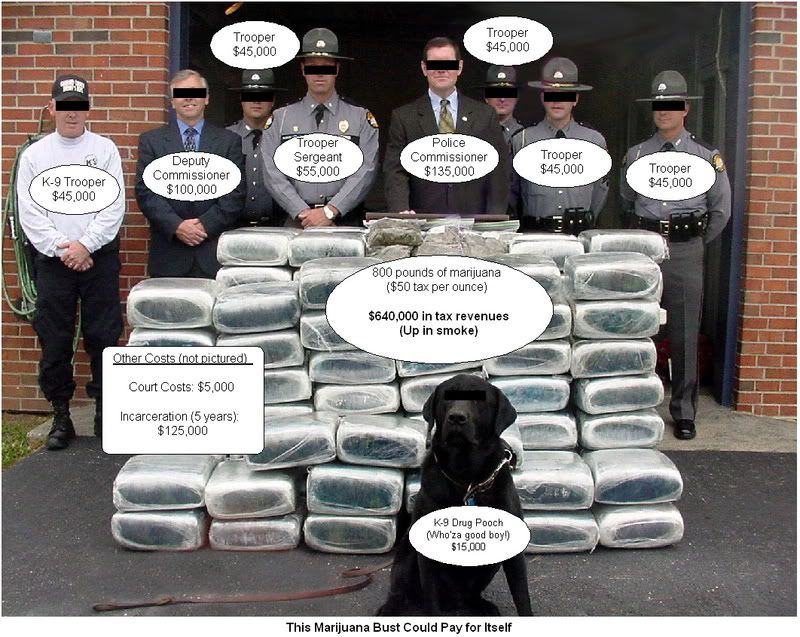
I've been Lazy lately. It's not even because I'm smoking too much, just too many midterms. Anyways, this post is lazy too, just a picture I think is worth looking at and thinking about.
It turns out that maybe, just maybe, drug prohibition is good for the world. I, of course, don't mean that it is good at keeping people from drugs but rather it is good because it just might be the largest source of liquid capital keeping many banks afloat right now.
From Reuters: The United Nations' crime and drug watchdog has indications that money made in illicit drug trade has been used to keep banks afloat in the global financial crisis, its head was quoted as saying on Sunday.
Vienna-based UNODC Executive Director Antonio Maria Costa said in an interview released by Austrian weekly Profil that drug money often became the only available capital when the crisis spiralled out of control last year.
"In many instances, drug money is currently the only liquid investment capital," Costa was quoted as saying by Profil. "In the second half of 2008, liquidity was the banking system's main problem and hence liquid capital became an important factor."